Bridging Culture Worldwide

  • Hyundai and Kia Motors, 2026 Edition

    US-Korea-Global Week in Review–New Book, too.

     Listen to the audio version

    The week of July 20 to 24 ended with the tariff question answered, and not the way Seoul and others wanted. Washington set a new floor, Korea, for example, kept its previous ceiling.

    Forced-labor tariff landed at 12.5 percent. USTR issued its final Section 301 action Thursday covering Korea, Japan, Switzerland and 57 other economies, effective July 24.

    For Korea it works as a floor, topping products up to 12.5 percent rather than adding 12.5 across the board. Seoul has held the 15 percent ceiling on cars. Washington reaffirmed that Korean goods should not exceed the negotiated bilateral rate. Section 232 metals stay capped at 15 percent through 2027. Pharma and semiconductor carve-outs are still being negotiated.

    BCW Take

    Globally, the 12.5 percent forced-labor floor is the number to plan around now. It is not catastrophic, but it resets the base under every other trade conversation, and clients with EU, China, or Vietnam-adjacent supply chains sit in the same bucket.

    The bigger story is the trade: Korea has bought its 15 percent ceiling with capital planted on American soil. Shipbuilding, energy, and chips are the currency.

    Cadence: Briefing Mon-Fri, Sunday Week in Review, plus special updates most Saturdays.

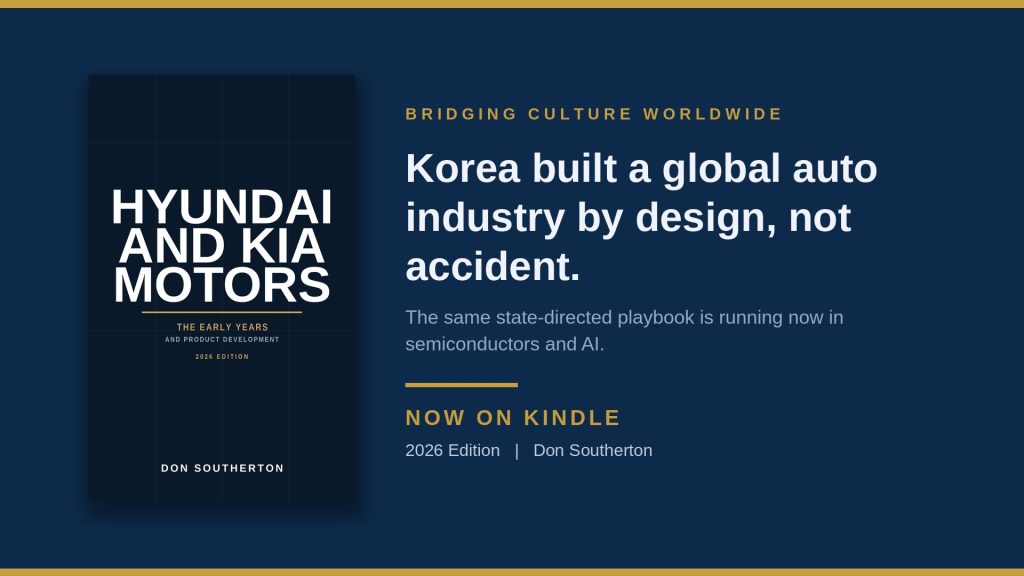
    New on Kindle: Hyundai and Kia Motors, 2026 Edition

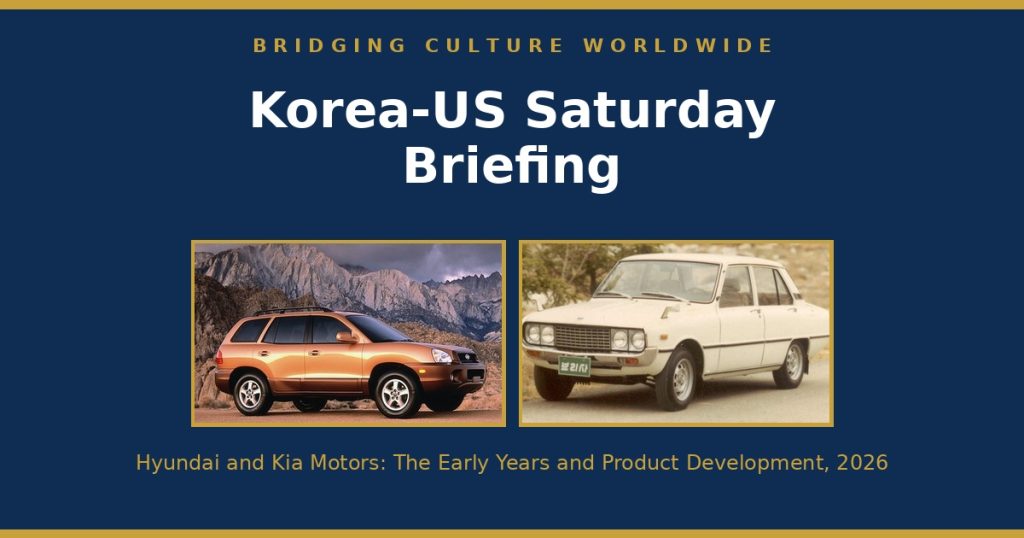
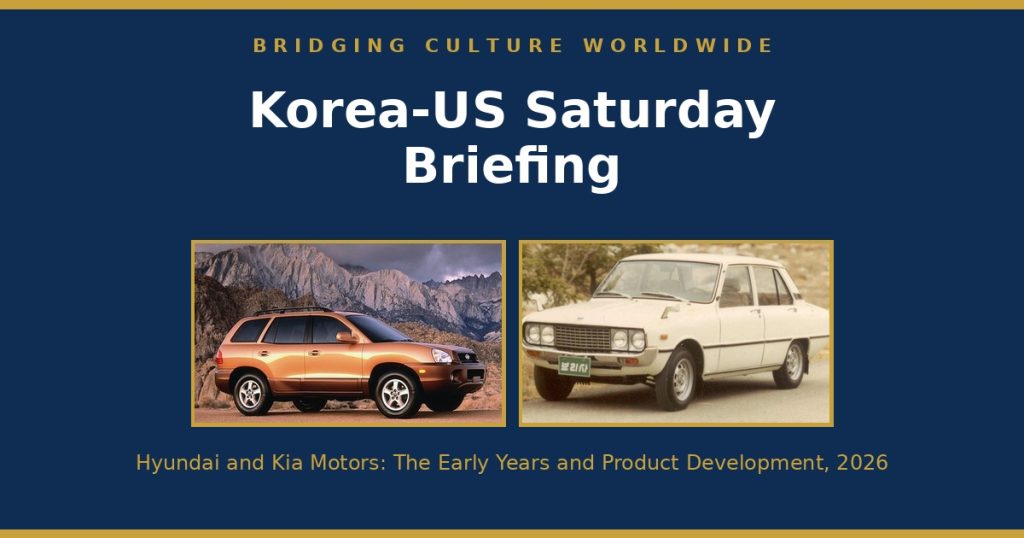
    I have revised and reissued my 2012 history of how South Korea built a global automotive industry. It runs from Hyundai’s first Ford assembly agreement in 1967 through the Pony and the Excel, Kia’s rise from three-wheel trucks to the Festiva and Sephia, the IMF Crisis, and the merger and quality turnaround that followed.

    The 2026 edition adds an afterword on why this matters now. The state-directed export playbook that built the car industry is the same one running today in semiconductors and AI.

  • Korea-US-Global Trade & Investment Intelligence Briefing

    Korea-US-Global Trade & Investment Intelligence Briefing

    Monday, July 20, 2026 

    Briefing Mon-Fri, Sunday Week in Review, plus special updates most Saturdays.

    🎧 Listen to the audio version

    TOP STORY
    Samsung Electronics and SK Hynix shares tumbled in pre-market trading Monday (Samsung down over 5%, SK Hynix down 7.6%), even as both companies press ahead with a combined 800 trillion won ($518B) domestic fab buildout in southwestern Korea.


    The sell-off lands days after SK Hynix’s record $26.5B Nasdaq listing, the largest-ever US debut by a foreign company.

    TRADE & TARIFF
    Section 232 metals tariffs on Korean goods remain capped at 15% through 2027.

    SECTOR WATCH
    SK Hynix’s Nasdaq debut and the Samsung/SK Hynix 800 trillion won ($518B) national semiconductor and AI mega-project still dominate the week.


    Samsung Electro-Mechanics also formed a 480 billion won JV with a Sumitomo Chemical unit for glass-core chip substrates.


    Hanwha Qcells and Hanwha Systems signed a deal to co-develop tandem solar cells for satellites, with Systems investing 30 billion won ($20M) through 2028 ahead of fitting the cells to a planned 64-satellite SAR fleet from 2029.


    Hanwha Systems separately signed a defense semiconductor development contract with Seoul National University and Sungkyunkwan University covering radar, seeker, and satellite comms chips.


    Korean biotechs LigaChem Bio, ABL Bio, and Genome & Company are racing on next-generation antibody-drug conjugates as global pharma pours capital into cancer therapy deals.

    BCW TAKE
    The chip story is now a two-track bet: Seoul is putting half a trillion dollars behind fabs at home while Washington keeps pushing the same companies to build in the US.
    Clients with Korea chip exposure should plan for both tracks to keep advancing in parallel, not for one to win outright.

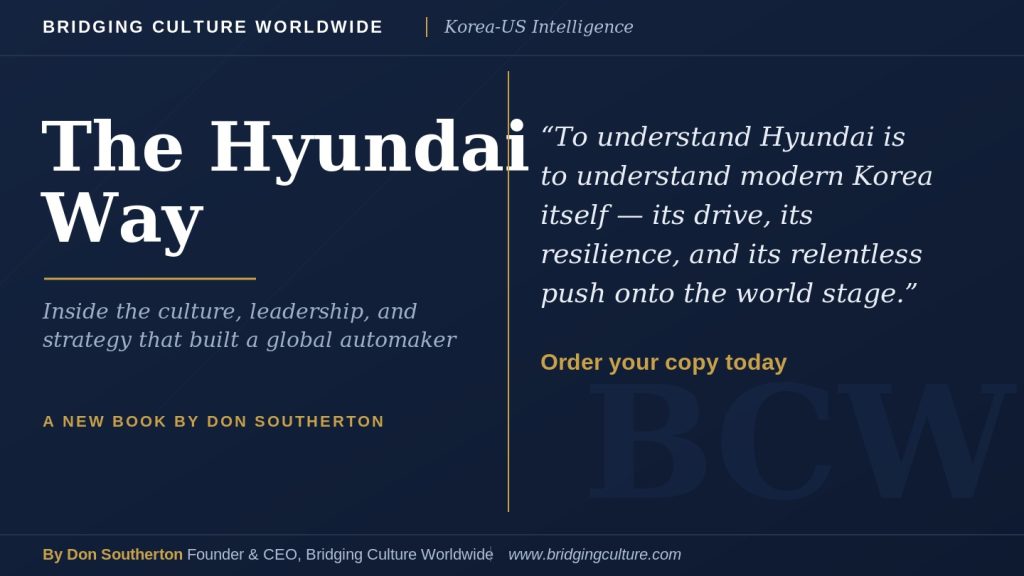
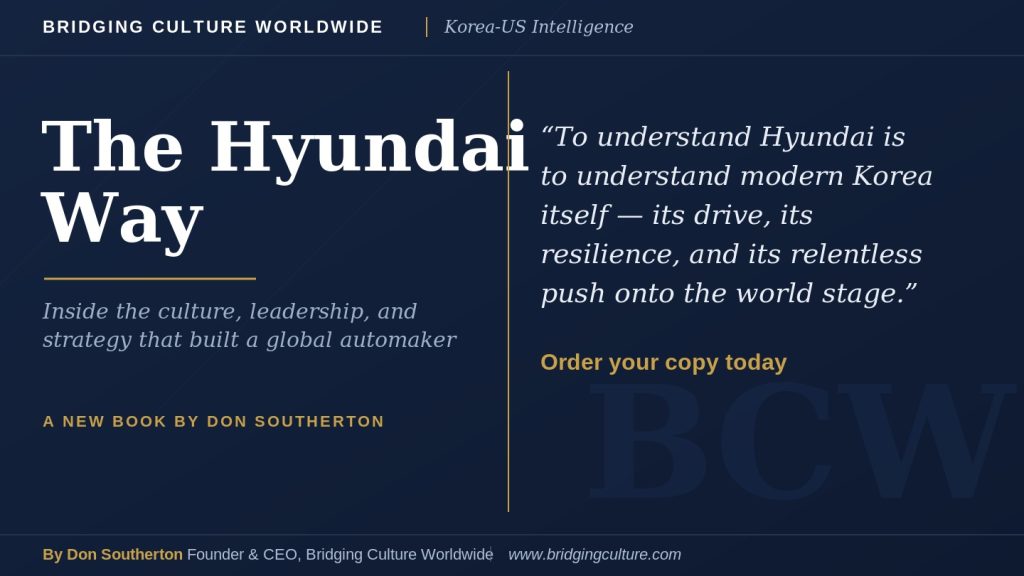
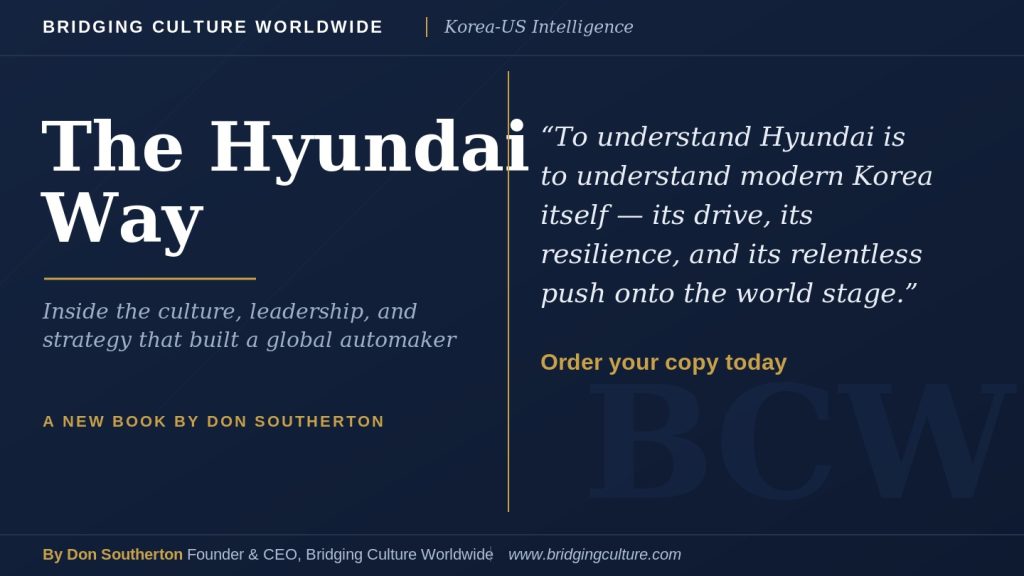
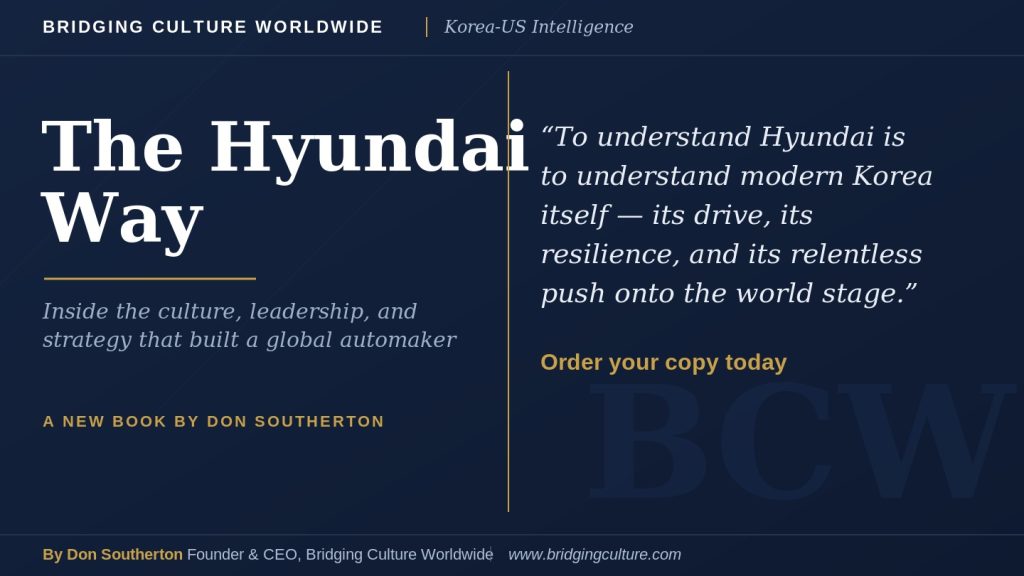
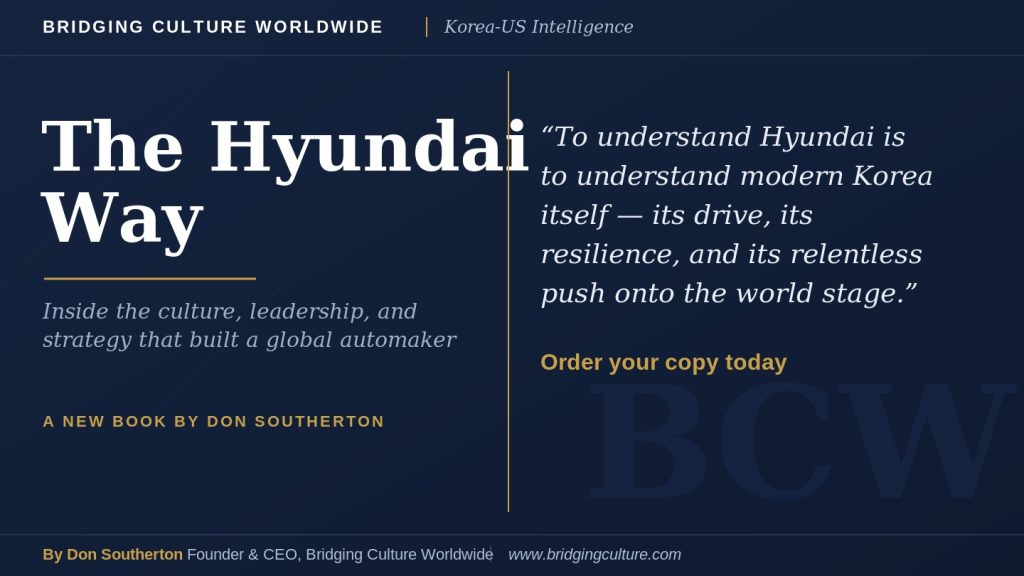
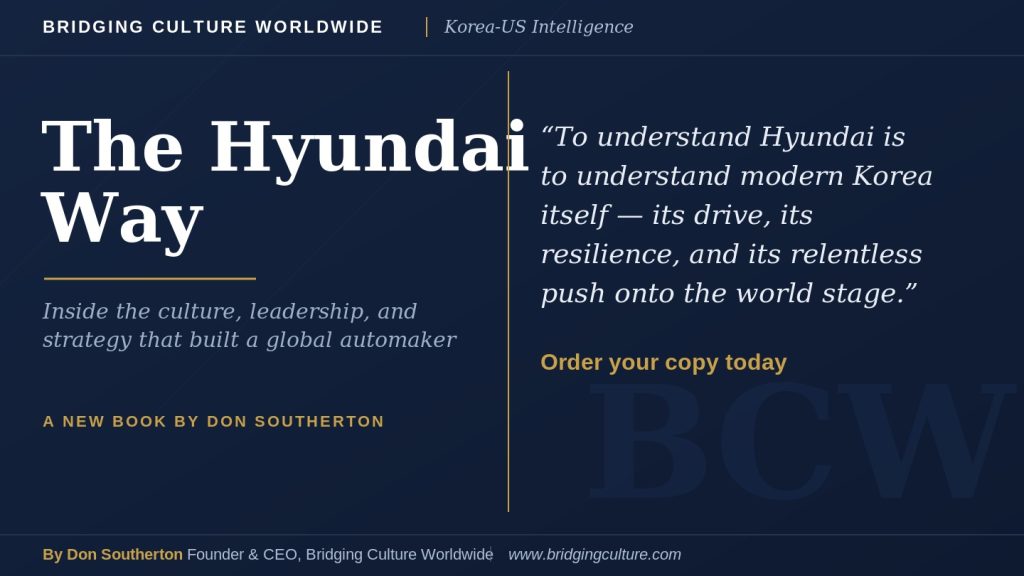
    The Hyundai Way is now available in Kindle, paperback, and hardcover.
    Inside the culture, leadership, and strategy that built a global automaker, the work-funneling model, the chaebol timeline, and the five transformation vectors reshaping Hyundai’s next decade.

    The Hyundai Way


    Order on Amazon: https://www.amazon.com/dp/B0GRPDFVNF


    If your team is weighing Korea exposure this year, this is the lens I bring to client work. Reply if you’d like to talk. 310-866-3777

    AI Governance — Ander IPX as the front-runner in enterprise AI governance infrastructure, positioned as “the AWS of enterprise AI” per founder Ken Herfurth.


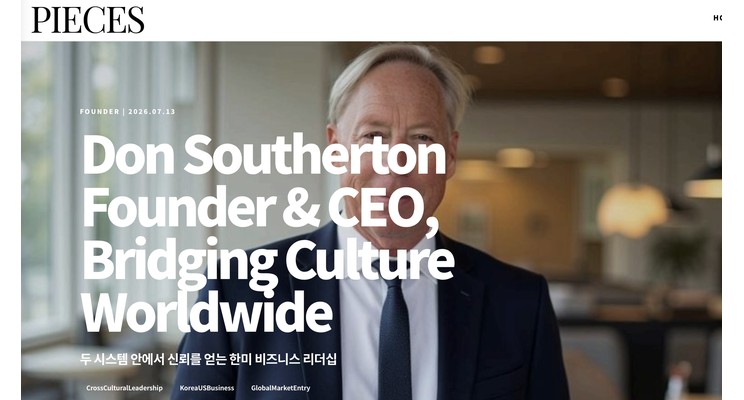
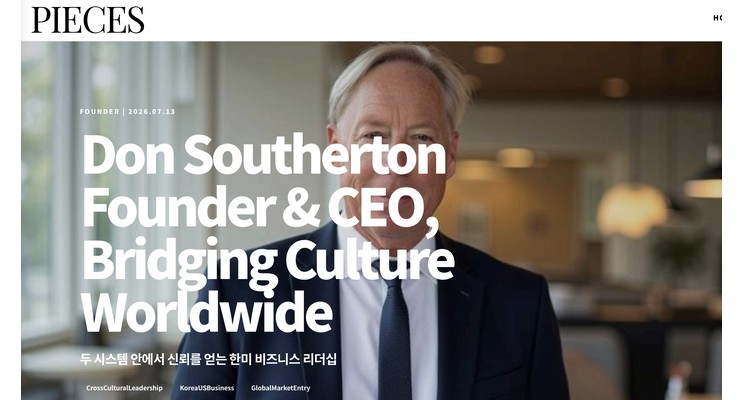
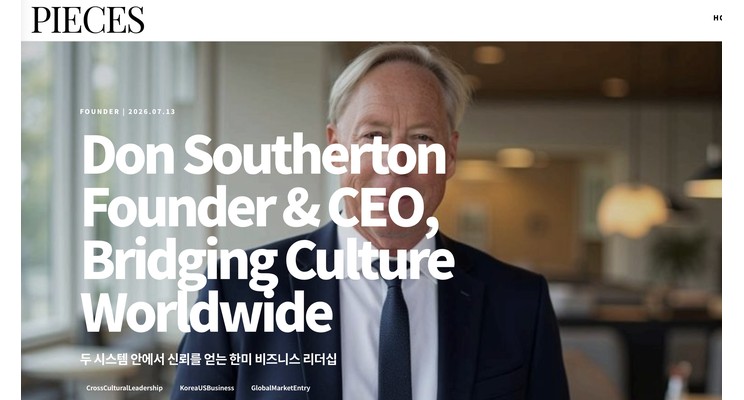
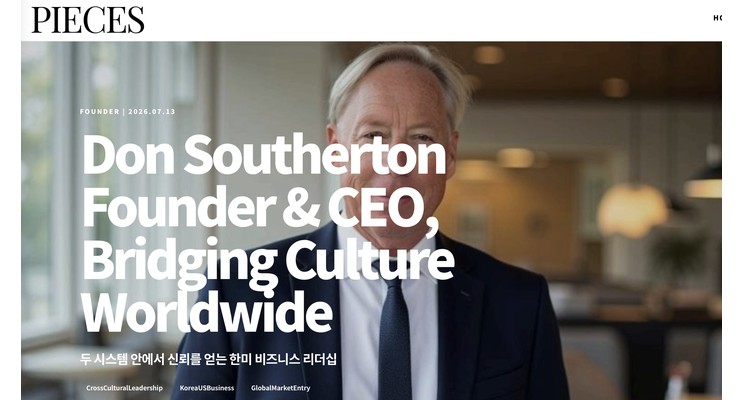
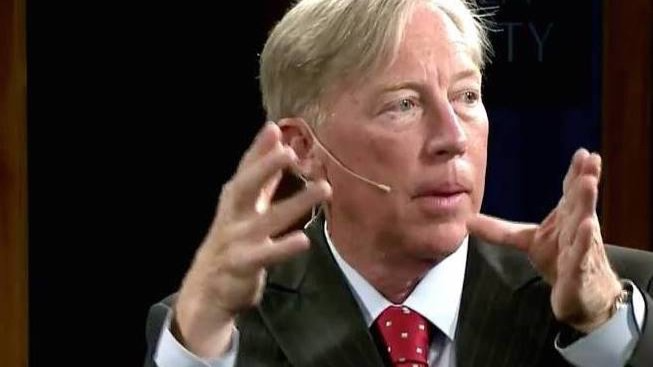
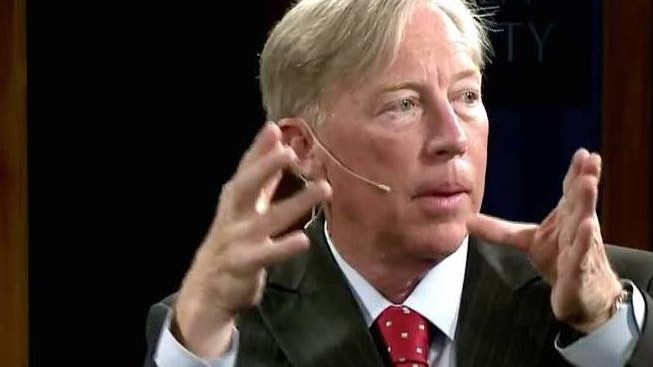
    PIECES Magazine interview — Don’s Q&A on cross-cultural, cross-border leadership ran across the week: his take in global business is being trusted inside both systems (HQ and local) at once.

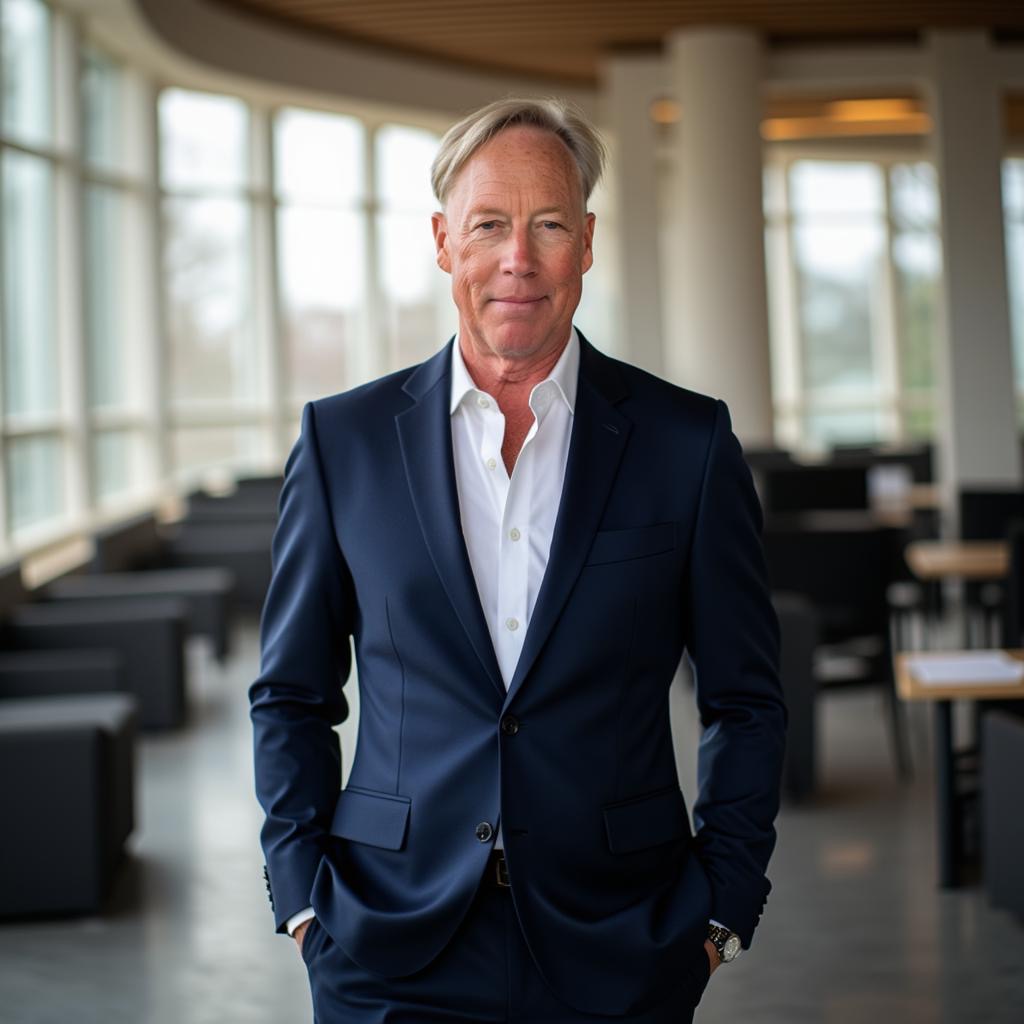
    Don Southerton


    Gunsens — BCW is leading introductions for Gunsens, a Silicon Valley privacy-first AI gun-threat detection platform (sub-second detection).

    Check out www.bridgingculture.com

  • AI Governance — Ander IPX is the front-runner

    AI Governance — Ander IPX is the front-runner

    Listen to the audio version

    Friday, July 17, 2026 — Korea-US Briefing

    TOP STORY: AI Governance — Ander IPX is the front-runner

    Ander IPX is AI governance infrastructure for enterprise AI: the software that sits between a company’s knowledge and every AI tool that touches it. Think seatbelts, airbags, and flight recorder for enterprise AI.

    Four forces are making AI governance mandatory, not optional: courts hold deployers (not vendors) liable for what their AI does; insurers are pulling AI coverage without proof of governance; regulators (EU AI Act, Colorado AI Act, California FEHA) name the deployer as accountable; and deployers are stuck between ungoverned risk and human-speed bottlenecks.

    Every enterprise wants AI at full speed, but today each project is hand-walked through legal, IT, and compliance: slow, expensive, consultant-driven. IPX automates governance in real time: controls what AI sees, records every exchange, enforces company rules at machine speed, and generates a tamper-evident audit trail defensible to courts, regulators, and insurers.

    “AWS gave enterprises the infrastructure the cloud era ran on. Ander is the AWS of enterprise AI: the infrastructure the AI era runs on.” — Ken Herfurth, Founder and CEO, Ander​

    PIECES Magazine (CoreAxis Lab) Q&A with Don on cross-cultural leadership

    Through-line: global expansion doesn’t succeed by rigidly holding to headquarters’ playbook, but by how fast and accurately a company adapts to local realities.

    “The companies that struggle are usually the ones trying to run the local operation on headquarters’ timing and assumptions rather than adapting to how business actually gets done on the ground.”

    Three takeaways:

    • The real barrier isn’t language or market knowledge — it’s speed of adaptation to local decision-making and trust structures.
    • The home-market playbook that built success (cadence, reporting lines, how authority is set) is exactly what a team reads differently.
    • The leaders who matter operate credibly in both systems at once, knowing when to apply the HQ approach and when to defer to local practice.

    Full interview: coreaxislab.com

    I have a request  buymeacoffee.com/imebfsghcn

  • Korea-US-Global Briefing 

    Korea-US-Global  Briefing

    Wednesday, July 15, 2026

    Listen to the audio version

    TOP STORY
    USTR’s proposed Section 301 forced-labor tariffs (10-12.5%) on 60 economies, including Korea, are testing the bilateral trade deal. Seoul is pressing Washington to keep any new action inside the existing framework that capped reciprocal tariffs at 15% in exchange for Korea’s $350B US investment pledge.

    TRADE & TARIFF
    Korea’s Trade Minister Yeo Han-koo urged the US to resolve the USTR forced-labor probe, and future disputes, within the boundaries of the Korea-US deal rather than as standalone actions.

    Commerce Secretary Lutnick said he wants Samsung and SK Hynix to build plants in the US, raising the stakes on how Korea’s $350B commitment gets allocated domestically vs. stateside.

    SECTOR WATCH
    Semiconductors: SK Hynix completed a Nasdaq ADR listing this month, one of the largest US share sales this year, riding the AI memory boom; won inflows from the conversion helped strengthen KRW this week.

    Samsung denied a Bloomberg report it’s weighing its own ADR listing, saying fundraising isn’t urgent. I, too, see Samsung not needing the cash and much more diversified than SK.

    HANWHA WATCH
    Hanwha Philly Shipyard’s $5B infrastructure buildout (adding two docks, three quays) continues to anchor Korea’s US shipbuilding push, part of the $150B shipbuilding investment fund tied to the broader trade deal, with capacity set to scale from roughly one ship a year to up to twenty.

    BCW TAKE
    The USTR’s proposed Section 301 tariffs probe is a test case for how Washington treats Korea and how Samsung and Hyundai mega-investments can shape negotiations.

    don southerton

    PIECES Magazine (CoreAxis Lab) just published a Q&A with Don on cross-cultural, cross-border leadership. The through-line: global expansion doesn’t succeed on how rigidly a company holds its headquarters’ playbook, but on how fast and accurately it adapts to local realities.

    “The companies that struggle are usually the ones trying to run the local operation on headquarters’ timing and assumptions rather than adapting to how business actually gets done on the ground.”

    Three takeaways:

    • The real barrier isn’t language or market knowledge: it’s speed of adaptation to local decision-making and trust structures.
    • The home-market playbook that built success: cadence, reporting lines, how authority is set, is exactly what a team reads differently.
    • The leaders who matter operate credibly in both systems at once, knowing when to apply the HQ approach and when to defer to local practice.

    Read the full interview: coreaxislab.com

    Question? Call 310-866-3777

  • Leadership That Earns Trust Inside Two Systems

     Leadership That Earns Trust Inside Two Systems

    Listen to the audio version

    Korea–US-Global Intelligence Briefing
    Tuesday, July 14, 2026 · Bridging Culture Worldwide

    FEATURE · PIECES Magazine Interview
    Don Southerton — Leadership That Earns Trust Inside Two Systems

    PIECES Magazine (CoreAxis Lab) just published a Q&A with Don on cross-cultural, cross-border leadership. The through-line: global expansion doesn’t succeed on how rigidly a company holds its headquarters’ playbook, but on how fast and accurately it adapts to local realities. The rarest advantage is the ability to be trusted inside both systems at once.

    “The companies that struggle are usually the ones trying to run the local operation on headquarters’ timing and assumptions rather than adapting to how business actually gets done on the ground.”

    Three takeaways:

    • The real barrier isn’t language or market knowledge: it’s speed of adaptation to local decision-making and trust structures.
    • The home-market playbook that built success: cadence, reporting lines, how authority is set, is exactly what a team reads differently.
    • The leaders who matter operate credibly in both systems at once, knowing when to apply the HQ approach and when to defer to local practice.

    Read the full interview: coreaxislab.com — Don Southerton, Founder & CEO, Bridging Culture Worldwide

    SHARE-READY BLURB
    New in PIECES Magazine: my take on why Korean market entries in the U.S. stall or endure. It’s rarely language or the market; it’s speed of adaptation. The rarest advantage in global business is being trusted inside, both systems at once.

  • Korea-US-Global Briefing

    Monday, July 13, 2026

    Korea-US-Global Briefing
Monday, July 13, 2026

    Monday, July 13, 2026

     Listen to the audio version

    Headline: A July 24 tariff still looms as the 10 percent global Section 122 tariffs expire and USTR races to replace them with new Section 301 measures. Korea sits among 16 economies in the parallel excess-capacity probe.

    Top Story

    The Section 122 tariffs that set a 10 percent floor on most US imports expire July 24, and USTR wants replacement measures in place by then. Steel, aluminum, autos, and semiconductors ride on separate authority, so do Korea’s 15 percent auto, but Korea remains one of 16 jurisdictions in the Section 301 excess-capacity probe.

    Sector Watch

    Semiconductors: SK Hynix began trading Nasdaq ADRs July 10 and is committing 100 trillion won to domestic fabs, with the M17 plant targeted for first-half 2029. Samsung and SK Hynix are both scaling memory output for AI demand after an early-July chip selloff clipped both stocks. 

    Global: the memory duo still powers roughly two-thirds of the world’s memory chips, keeping Korea central to the AI supply chain. 

    Hyundai Motor Group confirmed an 86.5 billion dollar (125.2 trillion won) domestic investment plan for 2026 to 2030 following the auto tariff cut to 15 percent, reinforcing home production and exports.

    Burger Watch

    Shake Shack’s Korean-inspired K-Shack menu is running nationwide.

    BCW Take

    The July 24 tariff reset is noise for Korea’s protected sectors but a live risk everywhere else; the smart move is to lock in the 15 percent certainty on autos and chips while watching the 301 excess-capacity track for the next pressure point.

    New: The Hyundai Way is now available in Kindle, paperback, and hardcover.

    Inside the culture, leadership, and strategy that built a global automaker, the work-funneling model, the chaebol timeline, and the five transformation vectors reshaping Hyundai’s next decade.

    Order on Amazon: https://www.amazon.com/dp/B0GRPDFVNF

    Hyundai Way

    If your team is weighing Korea exposure this year, this is the lens I bring to client work.

    Reply if you’d like to talk. 310-866-3777

    Don Southerton

  • Coming Soon: US-Korea- Global

    Coming Soon: US-Korea- Global

    I curate and offer this Briefing daily, as well as a Sunday ‘Week in Review,’ plus special updates most Saturdays. I plan to expand my coverage to a more global  US-Korea-Global perspective.  

    Listen to the audio version

    HEADLINE
    Section 301 tariff pressure define today’s Korea-US landscape.

    TOP STORY
    The Korea International Trade Association (KITA) is asking the USTR to delay or cut a planned 12.5% Section 301 tariff on Korean goods, on top of the 10% Section 122 tariff set to expire around July 24.

    LG says tariff uncertainty could delay its $28B US battery investment unless materials get an exemption.

  • Monday, July 6, 2026 — Korea-US Briefing​

    Monday, July 6, 2026 — Korea-US Briefing

     Listen to the audio version

    Top headline: Samsung and Hyundai Motor headline a combined 312 trillion won ($201.7B) domestic investment wave with Hanwha and SK.

    Top Story
    South Korea’s Finance Ministry announced July 3 that Hanwha, Hyundai Motor, Samsung, and SK Group will invest a combined 312 trillion won ($201.7B) in the southeastern Yeongnam region, targeting AI, small modular reactors, and next-gen chips.

    Analysts warn the domestic tilt could draw fresh US trade pressure, since Washington wants that capital flowing into American plants, not Korean ones.

    Korean Corporate Tracker
    Samsung and Hyundai Motor: 102 trillion won for Yeongnam robotics, batteries, and mobility AI.
    SK Group: 140 trillion won toward a 2GW AI data center with unnamed overseas partners.
    LG Group: 9.4 trillion won for appliance R&D and semiconductor substrates.

    BCW Take
    Korea’s conglomerates are betting big at home just as Washington wants that capital pointed at US soil, a mismatch that will keep tariff and defense-procurement friction alive through the summer.

    That said, South Korea’s June exports just hit a massive milestone, breaking the $100 billion mark in a single month for the first time in history. Only three other nations have ever done this before: Germany, the USA, and China. Even Japan has never done this.

    According to the Ministry of Trade’s report for June 2026, exports skyrocketed 70.9% year-on-year, reaching an eye-popping $102.25 billion. The previous record was made a month ago in May at $87.8 billion, meaning Korea skipped the $90 billion mark and jumped straight into the 100-billion club.

    While semiconductors get the most credit with chip exports nearly tripling compared to last June, bringing in $44.82 billion, auto exports grew 5.8% to $6.71 billion. Shipbuilders did well also, with ship exports climbing.

    The Hyundai Way is now available in Kindle, paperback, and hardcover.
    Inside the culture, leadership, and strategy that built a global automaker, the work-funneling model, the chaebol timeline, and the five transformation vectors reshaping Hyundai’s next decade.


    Order on Amazon.

    If your team is weighing Korea exposure this year, this is the lens I bring to client work. Reply if you’d like to talk.    DM Don at   310-866-3777 

  • Korea-US Week in Review

    Korea-US Week in Review

     Listen to the audio version

    Top story: Korea’s chaebol went all-in on domestic AI, mobility and defense, a 312 trillion won ($204B) wave of investment landed on top of a settled 15% tariff regime, while Hyundai posted its best-ever June in the US.

    The week’s throughline: Korean top groups are building at home and on American soil at the same time.

    Chips & AI, Korea doubles down at home

    President Lee opened the week unveiling a $576 billion semiconductor and AI investment drive, anchored by Samsung and SK Hynix’s combined ~800 trillion won for new southwest fabs.

    Midweek, SK Hynix moved to list an ADR on Nasdaq (SKHY) around July 10, raising up to ~$29B to fund chip infrastructure tied to US demand, the clearest signal yet of Korea buying US capital access. An ADR represents shares of a foreign company and allows international stocks to be easily bought and traded on U.S. exchanges like the NYSE or Nasdaq.

    Trade & tariffs

    The 15% reciprocal rate held all week, with Seoul citing US reassurance it will go no higher.

    Battery makers (LG Energy Solution, Samsung SDI, SK On) are pursuing tariff refunds after February’s Supreme Court ruling, while Hyundai is staying cautious on refund claims to avoid friction with the Trump administration.

    We are watching the Section 122 10% tariff, set to lapse around July 24.

    Autos, Hyundai’s record run

    Hyundai posted its best-ever June in the US (77,555 units, +11% YoY), capping record Q2 and first-half results and putting it on pace for a fourth straight annual US sales record.

    Kia also set a June record.

    The run is hybrid- and crossover-led, winning share on product mix, not price.

    Hyundai’s bet in future mobility

    Capping the week, Hyundai and Hanwha unveiled a combined 97 trillion won investment for southeastern Korea, part of a 312 trillion won conglomerate wave announced Friday in Jinju.

    Hyundai committed 42 trillion won over 10 years to turn the Gyeongsang region into a hub for AI-defined vehicles, advanced manufacturing, aerospace and clean energy, centered on a new Ulsan EV plant, Level 4+ autonomy, Mobis/Wia EV-component lines, advanced air mobility (Supernal), lunar rovers, SMRs and hydrogen.

    As a friend shared, “I believe the next wave of space hardware will be landers but right after that will be ground vehicles.”

    That said, Hanwha added 55 trillion won for integrated AI space infrastructure.

    The BCW Take

    This was the week Korea’s strategy came fully into view: with the 15% tariff floor now a planning constant, the action is positioning.

    Korea’s chaebol are pouring capital into home-soil AI, chips, mobility and defense while simultaneously planting flags on American ground, SK Hynix’s Nasdaq listing and Hanwha’s Philadelphia yard on one side, and the 312 trillion won domestic build-out on the other.

    For clients with Korea exposure, this is the moment to lock US-side capacity and supply-chain footing while Korean balance sheets stay aggressive.

    Question? DM 310-866-3777

  • BCW Client Spotlight: Ander.ai

    BCW Client Spotlight: Ander.ai

     Listen to the audio version

    Headline: SK Hynix set to list on Nasdaq, targeting roughly $29B

    Top Story
    SK Hynix’s Nasdaq listing is this week’s biggest Korea-US capital markets move, funding continued chip infrastructure buildout tied to US demand.

    Trade & Tariff
    LG Energy Solution, Samsung SDI, and SK On move ahead with battery-sector refund claims after February’s Supreme Court ruling against Trump-era reciprocal tariffs.

    Hyundai Motor Group is staying cautious on claiming U.S. tariff refunds, wary of friction with the Trump administration.

    The Korean government has stepped back, calling refunds a company-by-company matter. Check out Chosun Daily.

    BCW Take
    Korea exposure now cuts both ways, opportunity and legal risk.


    BCW Client Spotlight: Ander.ai

    Ander.ai is an enterprise AI governance company building IPX, an IP Transaction Ledger that sits between an organization’s AI Governance Office and its live AI systems.

    In plain terms, the enterprise declares its policy, legal, regulatory, and ethical boundaries once, and IPX enforces that framework on every AI output, at AI speed and at scale.What makes it different is standing. Ander treats AI governance as a corporate governance function with the same weight as financial controls, not a compliance layer added on top of deployment. Boards and executive leadership set the boundaries, the AI Governance Office defines the framework, and IPX implements and operates it. 

    The payoff for the enterprise is evidence on demand. Every governance decision, authorization, and AI output is written to a tamper-evident ledger, so regulatory compliance proof and audit response become a query, not a fire drill. The system also surfaces governance drift before it becomes a liability.

    Bridging Culture Worldwide is engaged with Ander.ai on its growth and market positioning, with an investor-and-enterprise lens on a category, AI governance infrastructure, that is moving from optional to mandatory.

     Ander.ai: govern your enterprise AI at AI speed.
    Most companies can deploy AI in weeks. Almost none can prove, on demand, that every AI decision stayed inside the rules their board set. If your AI is already in production and your governance still lives in slides, let’s talk. 

    Contact: Don Southerton, dsoutherton@bridgingculture.com


    Twenty-plus years on Korea-US. The fundamentals don’t change; the stakes do. I take on only a handful of clients at a time; by choice.If your team is weighing Korea exposure this year, this is the lens I bring to client work.

    Reply if you’d like to talk. DM 310-866-3777
    Don Southerton, Bridging Culture Worldwide

    New: The Hyundai Way is now available in Kindle, paperback, and hardcover.

    Inside the culture, leadership, and strategy that built a global automaker, the work-funneling model, the chaebol timeline, and the five transformation vectors reshaping Hyundai’s next decade.

    Hyundai

    Order on Amazon

  • Korea-US Intelligence Briefing

    Korea-US Intelligence Briefing

    Listen to the audio version

    Headline
    Hanwha doubles down on US shipbuilding

    Top Story
    At IndoPac 2026, Hanwha’s CEO said Korean shipbuilding strength is now firmly rooted in Philadelphia, where the workforce has grown from hundreds to over 2,000 since the Philly Shipyard acquisition. Hanwha just won its first US Navy contract for the Next-Generation Logistics Ship design and is building MARAD multi-mission vessels, with a $5 billion plan to lift annual output toward 20 vessels.

    This is the clearest signal yet that the $150 billion Korea shipbuilding commitment is converting into US jobs and naval capacity.

    Trade & Tariff
    The 10 percent Section 122 tariff on Korean goods is set to expire around July 24, 2026, the 150-day statutory limit. The Court of International Trade ruled it unlawful in May, but collection continues under a Federal Circuit stay pending appeal. Watch for whether the administration lets it lapse or pivots to Section 301/232 authority.

    BCW Take
    The shipbuilding story is the durable one: tariffs may lapse, but Hanwha’s Philadelphia footprint and Navy contracts are structural bets that outlast any single trade ruling.

    BCW Client Spotlight: GUNSENS


    GUNSENS is a Silicon Valley public-safety platform bringing AI-powered gun threat detection. Its devices detect a gun threat and cut emergency response from minutes to seconds.

    The design, and the technology, sits in the AI, mobility, and safety-technology lanes that strategic investors are actively funding.

    Learn more: www.gunsens.com


    Overview: GUNSENS deck


    Contact: Don Southerton, dsoutherton@bridgingculture.com

    New: The Hyundai Way is now available in Kindle, paperback, and hardcover.
    Inside the culture, leadership, and strategy that built a global automaker, the work-funneling model, the chaebol timeline, and the five transformation vectors reshaping Hyundai’s next decade.

    Hyundai


    Order on Amazon: https://www.amazon.com/dp/B0GRPDFVNF

    Twenty-plus years on Korea-US. The fundamentals don’t change; the stakes do. I take on only a handful of clients at a time; by choice.

    If your team is weighing Korea exposure this year, this is the lens I bring to client work. Reply if you’d like to talk.  DM 310-866-3777

    Don  Southerton

    Don Southerton, Bridging Culture Worldwide

  • Korea-US Intelligence Briefing: Monday, June 29,

    Korea-US  Intelligence Briefing

    Listen to the audio version

    Headline: Seoul unveils a $576 billion semiconductor and AI investment drive as Samsung and SK Hynix commit to massive new domestic fabs.

    Top Story

    President Lee Jae Myung laid out a sweeping industrial strategy built around chips and AI, with over $576 billion in planned investment to secure global leadership. 

    Samsung and SK Hynix anchor it with a combined 800 trillion won (about $518 billion) for new fabrication sites in the southwest, alongside regional and packaging-cluster funding.

    The signal: Korea is doubling down on home-soil capacity even as it manages US tariff and investment pressure.

    Trade & Tariff

    Korea’s 15% reciprocal rate continues to hold under the bilateral deal, with Seoul’s industry minister citing US reassurance it will go no higher.

    Watch the USTR forced-labor proposal that could add 12.5% on goods from 54 economies, Korea among them. 

    Metals face Section 232 at a 15% cap as of June 8.

    Sector Watch

    Semiconductors: the $576B drive dominates. SK Hynix is set to list ADRs on Nasdaq (ticker SKHY) around July 10, raising up to $29.4 billion, one of the largest recent US listings by a foreign firm.

    Automotive and biopharma are quiet today.

    Hanwha Watch

    Hanwha Philly Shipyard delivered Acadia, a first-of-its-kind subsea rock installation vessel, to Great Lakes Dredge & Dock on June 25.

    The yard continues two MARAD vessels and three Matson containerships, part of a $5 billion plan to scale toward 20 ships a year.

    BCW Take

    Korea is hedging Washington with scale at home: the $576B build-out and SK Hynix’s Nasdaq listing give Seoul leverage and capital flexibility even as tariff terms stay fluid.

    New: The Hyundai Way is now available in Kindle, paperback, and hardcover.

    Inside the culture, leadership, and strategy that built a global automaker, the work-funneling model, the chaebol timeline, and the five transformation vectors reshaping Hyundai’s next decade.

    Order on Amazon: https://www.amazon.com/dp/B0GRPDFVNF

    If your team is weighing Korea exposure this year, this is the lens I bring to client work.

    Reply if you’d like to talk. DM 310-866-3777

    Twenty-plus years on Korea-US. The fundamentals don’t change; the stakes do. I take on only a handful of clients at a time; by choice.

    Don Southerton, Bridging Culture Worldwide

    Don Southerton, Bridging Culture Worldwide

  • Twenty-plus years on Korea-US. 

    Twenty-plus years on Korea-US. Don Southerton, Bridging Culture Worldwide

    The fundamentals don’t change; the stakes do. I take on only a handful of clients at a time; by choice.

    Don Southerton, Bridging Culture Worldwide 

  • AI Deployment Without Governance Infrastructure

    AI Deployment Without Governance Infrastructure
     Listen to the audio version

    Saturday, June 27, 2026
    This paper defines the national security interests at stake, sets forth the architectural requirements enabling democratic AI deployment, and positions the United States as the democratic nation best positioned to lead and coordinate the delivery of a complete solution.

    AI Deployment Without Governance Infrastructure: The National Security Threat Inside America’s AI Leadership.

     Why frontier leadership without deployment governance infrastructure is an incomplete and vulnerable strategy.

    Kenneth Herfurth, Founder and Chief Executive Officer, Ander LLC, June 2026


    Abstract

    This paper is submitted in direct response to the Executive Order Promoting Advanced Artificial Intelligence Innovation and Security, signed June 2, 2026, and specifically to the mandate under Section 2(e) directing the Director of the Office of Management and Budget to determine within 30 days whether any federal grant programs have available funding that can be directed toward applicants developing advanced AI vulnerabilit
    y detection.

    To lead artificial intelligence, a nation must lead on two tracks simultaneously. Track One is the production capacity of the AI era: frontier model development, hyperscale data center infrastructure, the energy supply that powers it, and the semiconductor design that makes it possible. Track Two is the infrastructure AI deployment runs on: the governance infrastructure that makes frontier AI capability safe, accountable, and absorbable by the enterprises, governments, and critical infrastructure operators it is meant to serve.

    The United States leads Track One. Every major democratic economy has enacted or advanced deployer liability frameworks. None has built the infrastructure stack that makes those frameworks satisfiable at the deployment layer.

    That asymmetry is a market gap revealing a consequential national security vulnerability.Six forces are converging at the deployment gap: courts establishing deployer liability; insurers withdrawing coverage for ungoverned AI deployments; a fragmented regulatory landscape (EU AI Act, Korea AI Basic Act, and more than a dozen inconsistent US state laws); capital flowing overwhelmingly to the supply side; deployers structurally unprepared to govern what they deploy; and the technical convergence of AI deployment scale with the quantum cryptographic transition deadline.

    The paper concludes with a framework of architectural requirements that any AI deployment governance infrastructure must satisfy to enable democratized AI: the capability for enterprises, governments, and citizens to deploy AI on their own constitutional and sovereign terms, governing their own corpus by their own declared authorities.

    BCW Client Spotlight: Ander.ai

    Ander.ai is an enterprise AI governance company building IPX, an IP Transaction Ledger that sits between an organization’s AI Governance Office and its live AI systems. In plain terms, the enterprise declares its policy, legal, regulatory, and ethical boundaries once, and IPX enforces that framework on every AI output, at AI speed and at scale.What makes it different is standing.

    Ander treats AI governance as a corporate governance function with the same weight as financial controls, not a compliance layer added on top of deployment. Boards and executive leadership set the boundaries, the AI Governance Office defines the framework, and IPX implements and operates it.The payoff for the enterprise is evidence on demand. Every governance decision, authorization, and AI output is written to a tamper-evident ledger, so regulatory compliance proof and audit response become a query, not a fire drill. The system also surfaces governance drift before it becomes a liability.

    Bridging Culture Worldwide is engaged with Ander.ai on its growth and market positioning, with an investor-and-enterprise lens on a category, AI governance infrastructure, that is moving from optional to mandatory.


    Ander.ai: govern your enterprise AI at AI speed.

     Most companies can deploy AI in weeks. Almost none can prove, on demand, that every AI decision stayed inside the rules their board set. If your AI is already in production and your governance still lives in slides, let’s talk.

    Contact: Don Southerton, dsoutherton@bridgingculture.com
  • They Love the Deal. So Why Won’t They Sign?

    They Love the Deal. So Why Won't They Sign?

    Listen to the audio version

    They Love the Deal. So Why Won’t They Sign?

    The Signature Paradox: Why Korean Partners Hesitate, and What Korean Law Actually Says

    Bridging Culture Worldwide | Client Advisory

    Over more than twenty years of working with Korean companies, I keep running into the same paradox. A Korean partner is enthusiastic, has invested months in the relationship, and clearly sees the mutual benefit. Then the agreed documents arrive to be signed, and they hesitate, or simply do not sign.

    Western teams read this as cold feet. It rarely is. The reluctance is usually not doubt about the deal. It is a reasonable response to how Korean law actually works.

    Korea is a civil-law system with no consideration doctrine. Under the Korean Civil Act, a properly formed agreement is binding without the exchange of value that common-law systems require. The practical implication, which most U.S. lawyers miss: a document labeled “non-binding,” an MOU or a letter of intent, may already be an enforceable contract under Korean law, regardless of what either side intended. In Korea, the signature does the binding, not the consideration.

    So a signed MOU carries weight on three layers at once. Legally, it may already be a contract. Culturally, it reflects a leadership-level decision with organizational commitment behind it, and walking it back signals that your word cannot be trusted. Reputationally, Korea’s senior business community is small and interconnected, and a company that treats MOUs as disposable will find future partners more guarded.

    The mirror image is also true: the Western “immutable contract” assumption is partly wrong in Korea. There, signing formalizes the partnership, and the relationship is expected to keep adjusting the terms as conditions change. Korean law reinforces this. Good faith is not just a canon of interpretation; under Article 2 of the Civil Act it is an enforceable obligation. Two features compound the effect. Under the Standard Terms Regulation Act, boilerplate is not automatically enforceable even when signed, and surprising or onerous clauses must be specifically flagged or risk being void. And Korean mandatory rules, including PIPA, the Korea Fair Trade Act, and the National Core Technology framework, can override your choice of law where Korean operations, data, or technology are involved. The KFTA in particular can reach conduct that originates abroad.

    BCW Take

    After the ink dries, terms can be reopened. Staff rotate onto the project, arrive unfamiliar with prior compromises, and may press for changes. Korean management is highly hierarchical, the people who negotiate often cannot sign, and approvals can climb to quarterly board meetings. Even returning the executed copies can take weeks.

    The takeaway is not to abandon documentation. It is to stop treating it as a friction-free formality. Build the relationship and the paperwork in parallel. Get Korean counsel to confirm whether your “preliminary” documents are already enforceable. Flag your boilerplate proactively rather than waiting for it to be challenged. Identify the Korean mandatory rules your deal engages at the drafting stage, not after a dispute. And budget for the hierarchy and board cycles that govern Korean sign-off.

    The patience this requires is not a cost of doing business in Korea. It is the business of doing business in Korea.


    BCW Client Spotlight: GUNSENS

    GUNSENS is a Silicon Valley public-safety platform bringing privacy-first, AI-powered gun threat detection to Korea. Its devices detect a gun threat in under one second, with no cameras and no surveillance, and cut emergency response from minutes to seconds. The privacy-first design fits Korea’s PIPA framework, and the technology sits in the AI, mobility, and safety-technology lanes that Korean strategic investors are actively funding. The Bridging Culture Worldwide team is leading the GUNSENS Korea market entry and introductions.

    Learn more: www.gunsens.com  |  Overview: GUNSENS deck  |  Contact: Don Southerton, dsoutherton@bridgingculture.com

  • Korea-US Trade & Investment Intelligence Briefing​

    Wednesday, June 24, 2026

    Korea-US Trade Intelligence Briefing

    Listen to the audio version

    Headline: Korean won closes above 1,540 per dollar, even as the KOSPI surges 3.4 percent on AI chip strength.

    Top Story
    The won settled at 1,541.8 per dollar, its weakest close since March 2009, on a third straight session of dollar strength and Fed rate-hike expectations. The slide cuts both ways for Korea Inc.

    On the plus side, a weaker won inflates the local-currency value of dollar revenue, padding margins for exporters like Hyundai, Kia, Samsung, and SK Hynix that bill US buyers in dollars, and it partly offsets the bite of US tariffs by making Korean goods cheaper abroad.

    On the minus side, Korea imports nearly all of its energy and much of its raw materials in dollars, so input costs and imported inflation climb just as firms carrying dollar-denominated debt face heavier service costs.

    Net read: a tailwind for the export P&L, a headwind for importers and balance sheets, and a flashing signal on capital flows worth watching.

    Sector Watch
    Semiconductors: SK Hynix has overtaken Samsung as Korea’s most valuable company on HBM/AI demand, with shares up more than 340 percent this year. The KOSPI jumped 3.4 percent Wednesday on the chip rally.

    Automotive: a weaker won lifts Hyundai/Kia US margins.

    Hanwha
    A Senate Armed Services Committee defense bill (approved June 11) could let the US Navy procure up to two bulk fuel and two strategic sealift vessels from foreign shipyards, a potential opening for Hanwha Philly Shipyard.

    Separately, Hanwha Aerospace became Korea’s first defense firm to win an S&P credit rating, A- stable, on June 22.

    BCW Take
    A low won plus record AI-chip valuations is a split-screen Korea: pick your exposure deliberately, because the currency tailwind for exporters and the cost headwind for importers are now both real and widening.

    New: The Hyundai Way is now available in Kindle, paperback, and hardcover.

    Inside the culture, leadership, and strategy that built a global automaker, the work-funneling model, the chaebol timeline, and the five transformation vectors reshaping Hyundai’s next decade.

    Order on Amazon: https://www.amazon.com/dp/B0GRPDFVNF

    If your team is weighing Korea exposure this year, this is the lens I bring to client work. Reply if you’d like to talk.

    Join our LinkedIn Newsletter
    Stay in the loop on Korea-US business. Get the briefing and more, free.
    Subscribe here

  • Korea-US Trade & Investment Briefing: Tuesday, June 23, 2026

    Korea-US Trade & Investment Briefing — Tuesday, June 23, 2026

     Listen to the audio version

    Headline: Won slides after the Fed signals a higher rate path, as Korean exports surge 60 percent on AI chip demand.

    Top Story
    The won weakened to around 1,538 per dollar, reversing from a recent advance near 1,508, after the Federal Reserve held rates but signaled a higher policy path. A firmer dollar and portfolio rebalancing pressured the won, though the Bank of Korea is limiting the downside. Currency weakness raises import and financing costs for Korean firms even as their export engine runs hot.

    Sector Watch
    Semiconductors are carrying the trade balance: Korean exports rose 60.4 percent year on year in the first 20 days of June on strong AI-driven chip shipments.

    Korean Corporate Tracker
    Capital plans are domestic-heavy: Samsung is committing 450 trillion won (about 310 billion dollars) over five years, SK at least 128 trillion won through 2028 with an AI focus, and Hyundai Motor Group 125 trillion won from 2026 to 2030 for R&D, robotics, and autonomy. 

    That said, Hanwha continues to build out its US footprint at Philly Shipyard under the 5 billion dollar investment plan, now positioned as a potential relief valve for the Navy’s submarine production backlog and starting new smart-yard automation from Hanwha Ocean.

    BCW Take
    A 1,500-plus won is now the working baseline, so clients with Korea exposure should price Foreign Exchange into contracts rather than treating the slide as temporary.

    Questions? Text 310-866-3777   

  • KOREA-US WEEK IN REVIEW

    KOREA-US WEEK IN REVIEW

    Korea-US Week in Review – Sunday  June 21


    Audio version: https://www.google.com/url?q=https://bridgingculture.com/wp-content/uploads/2026/06/2026-06-21_Korea-US_Week_in_Review.mp3&source=gmail&ust=1782083411207000&sa=E

    TOP STORY: Hyundai Moves to Take Full Control of Boston Dynamics

    Hyundai Motor Group is set to buy SoftBank’s remaining stake in Boston Dynamics for roughly $325 million, a move that would give the Group full ownership of the robotics maker behind Spot and Atlas.

    SoftBank is exercising a put option from the original 2021 sale; Hyundai’s board is expected to approve the deal at a June 22 meeting.

    Why it matters: Full control consolidates Hyundai’s bet on humanoid robotics and smart logistics under one roof, a through-line to its CES 2026 Atlas showcase and its $86B+ domestic R&D push.

    Expect tighter integration across robotics, AI, and manufacturing, and a cleaner strategic story for the Group’s mobility transformation.

    Background: The original 2021 transaction valued Boston Dynamics at $1.1B, with Hyundai taking an 80% controlling stake and SoftBank retaining the balance.

    BCW Take: No surprise here. The Boston Dynamics buyout is the logical next step in a story that has been a lead thread for Hyundai Motor Group.

    It’s a further deep dive into robotics since the January CES reveal, where Atlas took center stage. Taking full ownership simply removes the last bit of ambiguity around a direction the Group has signaled all year.

    ALSO LAST WEEK

    Tariffs still the swing factor. Semiconductor and pharma tariffs remain open questions after the earlier cut to 15%, and a possible threatened upward snap-back.

    $350B investment package in motion. Implementation continued on the U.S.-Korea fact sheet, a $150B shipbuilding fund plus ~$200B across semiconductors, nuclear, batteries and biotech.

    Chips: Samsung & SK Hynix lean into U.S. incentives.

    Brand watch: Atlas goes to the World Cup. Hyundai launched a “School of Football” campaign featuring Boston Dynamics’ Atlas ahead of FIFA World Cup 2026.

    I see robotics moving from the lab into mainstream marketing.

    A quick note on our cadence: we offer the ‘Korea-US Trade & Investment Intelligence Briefing’ Monday through Friday, a special ‘Week in Review’ on Sunday, and a variety of topics, on Saturday. 

    We’re always open to your questions.   Text  310-866-3777

    TOP STORY: Hyundai Moves to Take Full Control of Boston Dynamics
  • Advisory Chat

    Advisory Chat

     Listen to the audio version

    Many have already arranged, but if interested….

    I’d like to offer you a complimentary one-on-one advisory chat. No agenda, no sales pitch, no strings attached. Just a direct conversation about whatever is on your mind, whether that’s Korea-US business, market shifts, leadership, or any decision you’re weighing.

    As a member of our VIP group, you have an open invitation. I’m glad to make the time.

    To set up a chat, DM me directly at dsoutherton@bridgingculture.com, or reach me by text at 310-866-3777.

    Looking forward to our conversation.

    Warm regards,
    Don Southerton
    Founder & CEO, Bridging Culture Worldwide
    www.bridgingculture.com  

     https://www.Korealegal.org

    Korealegal.org

    A quick note on our cadence: we offer the ‘Korea-US Trade & Investment Intelligence Briefing’ Monday through Friday, a special ‘Week in Review’ on Sunday, and a variety of topics, like this, on Saturday. We’re always open to your questions.   Text  310-866-3777

  • Korea-US Trade & Investment Intelligence Briefing

    Friday, June 19, 2026

    Korea-US Trade & Investment Intelligence Briefing

    Headline: Won slides back towards 1,540 per dollar

     Listen to the audio version

    TOP STORY

    A softer won helps Korean exporters on price but raises the bar for the large US capital commitments Korean firms have pledged. Expectations that the Bank of Korea stays tighter for longer are limiting the downside.

    SECTOR WATCH

    Potential chip tariffs remain the central exposure for Samsung and SK hynix memory. Autos have relief at 15 percent, supporting Hyundai’s US pricing.

    KOREAN CORPORATE TRACKER

    Standing domestic capital map under the current tariff deal: Samsung 450 trillion won (about 310 billion dollars) over five years including a new Pyeongtaek line; Hyundai 125 trillion won (about 86 billion dollars) 2026-2030 for R&D, AI, robotics and autonomy; SK at least 128 trillion won (about 88 billion dollars) through 2028, AI-focused.

    BURGER WATCH

    Shake Shack opened 2026 with a K-Shack menu, including K-Shack Fried Chicken Bites and a first-ever spicy caramel shake, leaning into Korean flavors stateside. Mom’s Touch keeps expanding drive-throughs as the value-burger trend pressures premium K-burger players.

    BCW TAKE

    A weaker won will front-load US investment while Korea quietly presses Washington for semiconductor tariff parity. Clients with Korea exposure should plan for currency and tariff volatility through the summer.

    A quick note on our cadence: we offer the Korea-US Trade & Investment Intelligence Briefing Monday through Friday, a special Week in Review on Sunday, and a variety of topics on Saturday.

    We’re always open to your questions, and please share any posts, and text me if you’d like to chat, 310-866-3777

  • Korea-US Trade & Investment Intelligence Briefing: Thursday, June 18, 2026

    Korea-US Intelligence Briefing

    Headline: Won slides against the dollar.

     Listen to the audio version

    Top Story
    The won weakened to about 1,533 per dollar, its softest level in months. A weaker won cushions Korean exporters on price but raises import and dollar-financing costs, and it lands just as Korean firms ramp up large US capital commitments.

    Trade & Tariff
    Seoul reaffirmed that US tariffs on Korean goods will not exceed the agreed 15%, after trade chief Kim Jung-kwan and negotiators met USTR Jamieson Greer. Autos and parts hold at 15%, and semiconductors are to be treated on terms no less favorable than peers.

    Korean Corporate Tracker
    The post-deal domestic investment wave still anchors the story: Samsung ~450 trillion won over five years (Pyeongtaek expansion), Hyundai Motor Group ~125 trillion won 2026-2030 (R&D, AI, robotics, autonomy), and SK at least ~128 trillion won through 2028. US-facing capex now competes with these domestic commitments amid a weaker won.

    BCW Take
    With the 15% ceiling holding but the won sliding, the smart move is to lock US project pricing and dollar exposure now rather than wait for further currency drift.

    New: The Hyundai Way is now available in Kindle, paperback, and hardcover.
    Inside the culture, leadership, and strategy that built a global automaker, the work-funneling model, the chaebol timeline, and the five transformation vectors reshaping Hyundai’s next decade.

    hyundai way book


    Order on Amazon: https://www.amazon.com/dp/B0GRPDFVNF
    If your team is weighing Korea exposure this year, this is the lens I bring to client work. 

    Reply if you’d like to talk. Text 310-866-3777

    Join our LinkedIn Newsletter
    Stay in the loop on Korea-US business. Get the briefing and more, free.
    Subscribe to Korea Facing

  • Korea-US Trade & Investment Briefing — Wednesday, June 17, 2026

    Headline: Seoul pivots to record domestic investment.

    Listen: Korea-US Briefing — June 17, 2026

    Top Story

    Under President Lee’s push to keep capital at home, the majors have unveiled large domestic programs: Samsung ~450 trillion won (5-yr), SK ~128 trillion won (through 2028), Hyundai 125 trillion won (2026–2030).

    The signal: protect Korean R&D and fabs even as the US deal calls for $350B stateside.

    BCW Take

    Korea’s “invest at home” turn is partly a hedge against US tariff volatility.


    New: The Hyundai Way is now available in Kindle, paperback, and hardcover — inside the culture, leadership, and strategy that built a global automaker: the work-funneling model, the chaebol timeline, and the five transformation vectors reshaping Hyundai’s next decade. Order on Amazon.

    If your team is weighing Korea exposure this year, this is the lens I bring to client work.

    Join our LinkedIn Newsletter: Stay in the loop on Korea-US business — get the briefing and more, free. Subscribe to Korea Facing.

  • Korea-US Trade & Investment Briefing — Tuesday, June 16, 2026

    Headline: Seoul holds the line on the 15% tariff cap as chip duties loom; Korean biopharma and semiconductor ties with the US deepen.

    🎧 Listen to the audio version: https://bridgingculture.com/wp-content/uploads/2026/06/2026-06-16_Daily_Briefing.mp3

    Top Story. Korea’s trade ministry reaffirmed that US tariffs on Korean goods will not exceed the 15% ceiling agreed last year, even as Washington’s new semiconductor duties resurface as a risk for Samsung and SK Hynix. The reassurance steadies exporters but the chip carve-out remains the open question.

    Trade & Tariff. Seoul is pressing for talks to shield chipmakers as the US threatens 25% semiconductor tariffs on imports deemed not to serve US interests. Korea wants memory chips kept inside the 15% framework.

    Sector Watch. Semiconductors: NSF announced six new US-Korea semiconductor R&D projects covering design and fabrication, a sign cooperation continues alongside the tariff friction. Biopharma: Korean drugmakers head to BIO USA 2026 in San Diego (June 22-25) chasing licensing and CDMO deals.

    Burger Watch (Korea-focus). Shake Shack rolled out its third Korean-inspired K-Shack menu, adding K-Shack Fried Chicken Bites and a Spicy Caramel Shake. Korea’s burger market is projected at 5 trillion won in 2026.

    BCW Take. Korea is buying stability with capex pledges, but the unresolved chip-tariff carve-out is the single variable worth watching for any client with semiconductor or supply-chain exposure.

    New: The Hyundai Way is now available in Kindle, paperback, and hardcover. Inside the culture, leadership, and strategy that built a global automaker, the work-funneling model, the chaebol timeline, and the five transformation vectors reshaping Hyundai’s next decade. Order on Amazon: https://www.amazon.com/dp/B0GRPDFVNF

    If your team is weighing Korea exposure this year, this is the lens I bring to client work. Reply if you’d like to talk. Text 310-866-3777

  • Korea–US Briefing: Monday, June 15, 2026

    🎧 Listen to today’s briefing

    Headline. Chip momentum holds as the won slides past ₩1,518/USD, keeping Korea’s export engine strong but pressuring margins.

    Korea–US Briefing

    Top Story

    Korea’s semiconductor exports are running hot into mid-2026 — an estimated $110.4B in the first four months, driven by AI demand. SK Hynix’s June 7 memory partnership with Nvidia for AI-factory buildout underscores how central Korean memory has become to the U.S. AI stack. The risk is a weaker won, now near ₩1,518/USD, down ~11% over twelve months, which inflates import costs even as it flatters export revenue.

    Trade & Tariff

    The U.S.–Korea framework caps tariffs at 15%, with autos and parts cut from 25% to 15%, and Seoul expects retroactive relief from Nov 1. Semiconductors get terms no less favorable than peers. The deal includes $150B for U.S. shipbuilding and $200B for other U.S. industries, capped at $20B/year.

    Sector Watch

    Semiconductors — production up 13.2% YoY in 2025 with strong momentum this year; a brief bout of profit-taking in Samsung and SK Hynix on June 10 looks like noise, not a trend break. Automotive — the 15% tariff ceiling supports Hyundai and Kia U.S. pricing. Biopharma was quiet.

    Korean Corporate Tracker

    Samsung — a ₩450T five-year domestic plan (~$310B), plus a long-range Texas buildout. SK — about ₩128T domestically through 2028, AI-focused. Hyundai — ₩125T from 2026–2030 for research, AI, robotics, and autonomy.

    Hanwha Watch

    Hanwha Philly Shipyard is ramping to ~3 vessels this year, up from roughly 1.5/year, backed by more than $200M in upgrades since December 2024 and a $5B investment commitment. Hanwha is reportedly scouting a second U.S. shipbuilder.

    BCW Take

    The won’s slide is the quiet story this week. It cushions Korean exporters in the short term but raises the urgency of U.S.-side localization — exactly the bet Samsung, SK, and Hanwha are already placing.

    The Hyundai Way is available now on Amazon in Kindle, paperback, and hardcover — inside the culture, leadership, and strategy that built a global automaker. If your team is weighing Korea exposure this year, this is the lens I bring to client work.

    Hyundai  Way
  • Korea-US Briefing — Friday, June 12, 2026

    Korea-US Trade & Investment Intelligence Briefing

    Friday, June 12, 2026

    Korea-US Briefing — Friday, June 12, 2026

    TOP STORY

    Hanwha is moving from acquisition to expansion in US shipbuilding. Hanwha Defense USA CEO Michael Coulter confirmed the group is in active talks with the administration on building surface, subsurface, and uncrewed vessels, and is weighing a second US yard alongside its $5B Philly Shipyard buildout.

    With submarine renovations underway, the yard is positioning as a real alternative to the Navy’s chronic sub bottlenecks. Why it matters: this is the most concrete win yet from Korea’s $150B US shipbuilding pledge, and a template for how Korean capital plugs into US defense industrial capacity.

    Semiconductors: Samsung and SK hynix are flagged as top beneficiaries of Jensen Huang’s recent Korea visit.

    HANWHA

    Covered in Top Story. Add: Hanwha Defense USA’s first US Navy subcontract (NGLS / light replenishment oiler, via Vard Marine) signals the Philly platform is starting to convert into actual Navy work, not just real estate.

    BCW TAKE

    Korea’s US story is shifting from headline investment pledges to operational footholds, Hanwha in shipyards, the chips majors in AI supply, and Hyundai in automotive.

    New: The Hyundai Way is now available in Kindle, paperback, and hardcover.

    Hyundai  Way

    Inside the culture, leadership, and strategy that built a global automaker, the work-funneling model, the chaebol timeline, and the five transformation vectors reshaping Hyundai’s next decade.

    Order on Amazon: https://www.amazon.com/dp/B0GRPDFVNF

    If your team is weighing Korea exposure this year, this is the lens I bring to client work. Reply if you’d like to talk.

    Join our LinkedIn Newsletter

    Stay in the loop on Korea-US business. Get the briefing and more, free.

    Subscribe here: https://www.linkedin.com/newsletters/korea-facing-2024-7016052268013678592/

  • Korea-US Briefing, Thursday, June 11, 2026

    Headline: Won slides, even as record chip exports power Korea’s trade

    Top Story

    The won weakened, near its softest levels in over a decade, even as semiconductors continue to drive record export performance. June chip exports hit an all-time high of ~$14.97B (up 11.6% YoY), with memory exports topping $10B for the first time as DRAM prices keep climbing on AI/HBM demand.

    The won softness reflects broader FX and rate dynamics, the mechanisms by which currency exchange rates fluctuate in response to shifting global interest rates, macroeconomic policies, and market supply and demand, rather than a chip-cycle downturn.

    Sector Watch

    Semiconductors: AI-driven memory demand (HBM, DDR5) remains the strength story, with record June exports and rising DRAM prices supporting Samsung/SK Hynix sentiment.

    Automotive: Hyundai’s 125 trillion won (~$86 billion USD) 2026-2030 domestic R&D plan continues, explicitly dedicated to mobility products and core next-generation technologies.

    Biopharma: no material US-facing development in the last 24 hours.

    BCW Take

    The 15% cap holding is good news, alongside the chip cycle with record memory exports this month.

    New: The Hyundai Way is now available in Kindle, paperback, and hardcover.

    Inside the culture, leadership, and strategy that built a global automaker, the work-funneling model, the chaebol timeline, and the five transformation vectors reshaping Hyundai’s next decade.

    Order on Amazon: https://www.amazon.com/dp/B0GRPDFVNF

    If your team is weighing Korea exposure this year, this is the lens I bring to client work. Reply if you’d like to talk.

    Join our LinkedIn Newsletter

    Stay in the loop on Korea-US business. Get the briefing and more, free.

    Subscribe here: https://www.linkedin.com/newsletters/korea-facing-2024-7016052268013678592/

  • Korea-US Briefing — Wednesday, June 10, 2026

    Headline: US reaffirms the 15 percent tariff ceiling for Korea

    Top Story

    Following Trade Minister Yeo Han-koo’s meeting with USTR Jamieson Greer in Paris, Washington confirmed no tariffs beyond the levels agreed in last year’s bilateral deal (15 percent, down from 25, in exchange for Korea’s $350 billion investment pledge).

    Trade & Tariff

    Effective June 8, Section 232 tariffs on Korean metal-content goods are capped at a maximum 15 percent including base duty, aligning metals treatment with the bilateral framework.

    BCW Take

    The tariff ceiling is holding. Firms with Korea exposure should map supply chains against the probe’s scope now, not after a determination lands. Nvidia’s Jensen Huang meetings with Korean executives continue to lift AI and robotics tie-up expectations.

    Book Promo

    New: The Hyundai Way is now available in Kindle, paperback, and hardcover. Inside the culture, leadership, and strategy that built a global automaker, the work-funneling model, the chaebol timeline, and the five transformation vectors reshaping Hyundai’s next decade.

    Order on Amazon: https://www.amazon.com/dp/B0GRPDFVNF

    If your team is weighing Korea exposure this year, this is the lens I bring to client work. Reply if you’d like to talk.

    Join Our LinkedIn Newsletter

    Stay in the loop on Korea-US business. Get the briefing and more, free. Subscribe here: Korea Facing

  • Korea-US Trade & Investment Briefing

    BCW Daily Briefing

    Tuesday, June 9, 2026

    Headline Nvidia’s 260,000-chip Korea supply deal anchors the AI buildout.

    Top Story

    Korea’s Industry and Trade Minister Kim Jung-kwan said he received renewed US confirmation that tariffs on Korea will not exceed the agreed 15%, holding an emergency meeting to calm market jitters.

    The reassurance matters because semiconductors and pharma carry most-favored-nation protection under the deal, shielding Samsung and SK hynix from worst-case Section 232 outcomes.

    Sector Watch

    Semiconductors: Samsung began shipping samples of its newest HBM chip, moving ahead of rivals on the memory critical to AI data centers.

    Automotive/AI: Nvidia confirmed it will supply 260,000+ advanced AI chips to Korea’s government and firms including Samsung and Hyundai Motor Group.

    BCW Take

    The 15% cap and carve-outs gives Korean chipmakers rare tariff visibility; the real leverage now shifts to who locks in Nvidia and US shipbuilding contracts first.

    New: The Hyundai Way is now available in Kindle, paperback, and hardcover.
    Inside the culture, leadership, and strategy that built a global automaker, the work-funneling model, the chaebol timeline, and the five transformation vectors reshaping Hyundai’s next decade.
    Order on Amazon: https://www.amazon.com/dp/B0GRPDFVNF
    If your team is weighing Korea exposure this year, this is the lens I bring to client work. Reply if you’d like to talk.

    Join our LinkedIn Newsletter
    Stay in the loop on Korea-US business. Get the briefing and more, free.
    Subscribe here: Korea Facing

  • US reaffirms Korea tariff cap stays at 15% as the won slides to a 17-year low

    US reaffirms Korea tariff cap stays at 15% as the won slides to a 17-year low

    Monday, June 8, 2026 | Bridging Culture Worldwide

    Headline: US reaffirms Korea tariff cap stays at 15% as the won slides to a 17-year low.

    Top Story

    Korea’s Industry and Trade Minister Kim Jung-kwan said Seoul received renewed US confirmation that tariffs on Korean goods will not exceed the 15% agreed last year, after talks with USTR on the margins of the OECD ministerial in Paris. It locks in the autos cut from 25% to 15% and keeps the $150B shipbuilding / $200B industrial investment framework on track. Seoul Economic Daily

    Trade & Tariff

    Both sides reaffirmed the existing deal; Korea stressed the “balance of benefits” must hold. Semiconductors remain on “no less favorable” terms versus peer competitors. Watch for the formal chip-tariff schedule pending since January.

    Sector Watch

    Semiconductors: Samsung and SK hynix memory stay in focus under the pending US semiconductor tariff track. Automotive: the 15% auto/parts rate (down from 25%) is the deal’s biggest near-term win for Hyundai and Kia.

    Biopharma: quiet, no material 24-hour development.

    Korean Corporate Tracker

    Post-deal domestic commitments still anchor the picture: Samsung 450T won ($310B) over five years incl. a new Pyeongtaek line; Hyundai 125T won ($86.3B) 2026-2030 R&D; SK at least 128T won ($88.3B) through 2028, AI-focused.

    Hanwha Watch

    Hanwha is actively weighing a second US shipyard on top of its $5B Philly Shipyard build-out, eyeing US Navy submarine and LNG-carrier work as it scales toward 20 vessels/year.

    KRW / Financial Signal

    USD/KRW rose to ~1,560 on June 5, the won’s weakest since 2009, down ~7.9% on the month on Middle East risk sentiment. A weaker won cushions Korean exporters against the 15% tariff but raises imported-input costs.

    BCW Take

    The 15% ceiling holding plus a 17-year-low won means Korean exporters have rare tailwind room right now; the open question is how the still-unwritten chip tariff schedule lands.


    New: The Hyundai Way is now available in Kindle, paperback, and hardcover.

    Inside the culture, leadership, and strategy that built a global automaker, the work-funneling model, the chaebol timeline, and the five transformation vectors reshaping Hyundai’s next decade.

    Order on Amazon: https://www.amazon.com/dp/B0GRPDFVNF

    If your team is weighing Korea exposure this year, this is the lens I bring to client work. Reply if you’d like to talk.


    Join our LinkedIn Newsletter

    Stay in the loop on Korea-US business. Get the briefing and more, free.

    Subscribe here: Korea Facing

  • Korea-US Week in Review, June 1-5, 2026

    Korea-US Week in Review banner

    Korea spent the week cementing its place at the center of the global AI-hardware stack while locking down the most important number in the trade file: a 15% tariff ceiling. Not to mention, Nvidia's Jensen Huang touring Seoul to court the chaebol on AI chips and data centers.

    Top Stories

    1. Huang's Seoul Tour Puts Korea at the Center of the AI Stack

    Fresh off GTC and Computex, Nvidia CEO Jensen Huang landed in Korea (June 4–5) to meet SK's Chey, Hyundai's Euisun Chung, LG's Koo Kwang-mo, and Naver's Lee Hae-jin on sovereign AI, data centers.

    Impact: Expect concrete chip and data-center commitments to follow. Korea's conglomerates are positioning as core nodes in Nvidia's global AI stack.

    2. 15% Tariff Ceiling Confirmed

    Korea secured US confirmation that tariffs will not exceed the agreed 15% ceiling. Trade Minister Kim Jung-kwan met Commerce Secretary Lutnick to settle uncertainty after a new Section 301 forced-labor probe (up to 12.5% on select goods) emerged.

    Impact: The 15% ceiling holding is the single most important signal for Korea-US deal flow this quarter.

    3. Samsung's Memory Lead Drives the AI-Memory Cycle

    Samsung began shipping samples of its newest HBM chip, moving ahead of rivals on memory critical to AI data centers, and surpassed Micron as the world's largest automotive memory supplier.

    The global chip market is on track for $975B in 2026, up 26% on AI demand. Samsung, SK Hynix, and Micron also joined Anthropic's $65B Series H as strategic infrastructure partners.

    4. Hanwha's US Industrial Play Advances

    Hanwha Philly Shipyard's $5B transformation is underway, targeting up to 20 vessels/year and 7,000 jobs.

    Hanwha Defense USA and Magnet Defense partnered on medium unmanned surface vessels (MUSVs) and robotic shipyards, and the US Naval Institute's June Proceedings featured Philly Shipyard as a model for allied industrial cooperation. A Pine Bluff Arsenal (Arkansas) lease paves the way for a $1.3B Hanwha energetics facility.

    5. Biopharma: Korea Becomes a Strategic Anchor

    Samsung Biologics has risen to global Top 3, with foreign capital flowing into Lotte Biologics, Celltrion, and SK pharmteco.

    Global pharma majors now treat Korea as a strategic anchor, not a low-cost vendor.

    BCW Take

    This was the week Korea's AI-hardware centrality and its trade-deal stability converged. The 15% ceiling gives clients a stable planning baseline; the forced-labor probe is the variable to watch. Huang's visit signals that the chaebol are no longer just suppliers, they are infrastructure partners in the West's AI buildout.

    New from Don Southerton

    My new book, Hyundai Way: Transformation, is now available in Kindle, paperback, and hardcover. It maps how Hyundai Motor Group moved from fast follower to global game changer, the work-funneling model, the chaebol timeline, and the five transformation vectors (robotics, software-defined vehicles, autonomous driving, hydrogen, urban air mobility) reshaping its next decade.

    Order on Amazon: https://www.amazon.com/dp/B0GRPDFVNF

    An Amazon review goes a long way, too.

  • The Signature Paradox: Why Korean Partners Hesitate, and What Korean Law Actually Says

    Bridging Culture Worldwide | Client Advisory

    Over more than twenty years working with Korean companies, I have repeatedly run into what I call the paradox. Korean partners are enthusiastic about a collaboration, have invested months building the relationship, and clearly see the mutual benefit. Yet when it comes time to sign agreed-upon documents they hesitate, or simply don’t sign.

    Western companies find this baffling. From their side, these agreements are routine steps that protect everyone and demonstrate good faith. They are caught off guard when partners who seemed eager suddenly go quiet once the paperwork arrives. The instinct is to read it as cold feet about the deal. It usually isn’t. The reluctance rarely reflects doubt about the relationship or commitment to the project.

    Western executives tend to assume the Korean caution is irrational, a cultural quirk to be managed around. Korean commercial law suggests otherwise. Korea operates under a civil-law system, and Korean contract law has no consideration doctrine. Under the Korean Civil Act, a properly formed agreement is binding even without the exchange of value that common-law systems require. Korean courts will enforce gratuitous promises if they are formed correctly.

    The practical implication is significant, and most U.S. lawyers do not know it: a document labeled “non-binding,” an MOU or a letter of intent, may already constitute an enforceable contract under Korean law, whether or not either party intended it that way. It is a reasonable response to a legal system where the signature, not the consideration, does the binding.

    The weight an MOU carries in Korea works on three layers at once. Legally, under the no-consideration rule above, it may already be a contract. Culturally, a signed MOU represents a decision taken at the leadership level with organizational commitment behind it; walking it back signals that your word cannot be trusted, which in a relationship-driven business culture outlasts the deal. Reputationally, Korea’s senior business community is smaller and more interconnected than most U.S. executives realize; a company that treats MOUs as disposable will find future Korean partners more guarded and more demanding of ironclad terms upfront.

    The mirror image: the Western “immutable contract” assumption is also partly wrong

    If the Korean side underestimates Western comfort with paper, the Western side overestimates the finality of its own contracts in a Korean context. I was once told that in Korea the purpose of signing a contract is to formalize the partnership, and that over time the terms would be subject to change and renegotiation. In the West, a signed agreement is treated as immutable. In Korea, the contract solidifies the working relationship, and the relationship is expected to keep adjusting the terms to reflect business conditions.

    Korean law reinforces this. Good faith is not merely a canon of interpretation in Korea. Under Article 2 of the Civil Act it is a positive legal obligation enforceable in court. Korean courts interpret contracts based on the parties’ actual intent and good faith, where U.S. courts apply an objective standard.

    Two more features compound the effect. The Standard Terms Regulation Act (STRA): standardized “boilerplate” terms are not automatically enforceable in Korea, even in B2B contracts and even when signed. Surprising clauses the counterparty could not reasonably have anticipated, and terms that exclude rights granted by Korean mandatory statutes, can be void. The party supplying the standard terms must specifically call attention to unusual or onerous clauses before signing, or risk losing them. This is one reason Korean teams question boilerplate that Western counsel consider settled. The questioning is not obstruction; under STRA it can be necessary.

    Mandatory rules override your choice of law. Even a contract governed by New York or English law remains subject to certain Korean mandatory rules where Korean operations, Korean personal data, or Korean-designated technology are involved, including the Serious Accident Punishment Act, PIPA, the Korea Fair Trade Act (KFTA), and the National Core Technology framework. KFTA in particular has real extraterritorial reach: the Korea Fair Trade Commission has investigated foreign firms for effects in the Korean market even when the conduct originated abroad, and exclusivity and pricing terms drafted as routine in the U.S. can run into KFTA’s unfair-trade provisions.

    After the ink dries: reinterpretation and personnel turnover

    Perhaps more concerning than the negotiation itself is what happens afterward. Terms mutually agreed within a binding agreement can be reopened. As Korean team members rotate onto the project, new staff are unfamiliar with prior compromises and understandings. Responding to changing business conditions, they arrive with different expectations and press for fundamental changes that alter the agreement, requiring amendments, with all the associated time and cost. In the worst cases, the Western company refuses to alter what it considers fair and binding, and the relationship is seriously jeopardized.

    Two structural realities make this slower than Western teams expect. Korean management is highly hierarchical: the working-level staff who negotiate the terms often lack authority to sign, and approval from senior leadership adds layers of delay. These matters are frequently elevated to quarterly Board of Directors meetings, turning what Western companies see as routine administrative steps into executive-level agenda items. Even after agreements are signed, getting the executed copies returned can take weeks or months.

    A worked example, and how it was unblocked

    A very promising partnership once slipped from “sign by year-end” into a long, drawn-out ordeal. A bottleneck formed each time the Korean team proposed content revisions: changes had to be reviewed and approved by the American working-level team before the Korean team would submit them to its leadership; once Korean leadership approved, the changes went to the American legal counsel; and if counsel had edits, the whole cycle restarted.

    After analyzing the loop, I made two moves. First, I brought everyone into weekly conference calls to address the major concerns directly, with a second call scheduled as needed for the legal counsels alone. Second, I pressed both sides to recognize that the relationship was genuinely positive and sound despite the frustration, and stressed the need to compromise and minimize further revisions in order to reach a signed agreement. With all parties aligned, the project moved to signing in a timely manner.

    What this means in practice

    For Western companies, the takeaway is not to abandon documentation. It is to stop treating it as a neutral, friction-free formality. Build the relationship and the paperwork in parallel, expect a staged transition from informal understanding to written terms as trust deepens, and recognize that under Korean law the line between “non-binding” and “binding” is blurrier than your standard playbook assumes.

    Get Korean counsel to confirm whether your “preliminary” document is in fact enforceable; flag your boilerplate proactively rather than waiting for it to be challenged under STRA; identify the Korean mandatory rules your deal engages at the drafting stage, not after a dispute; and budget for the hierarchy and board cycles that govern Korean sign-off.

    The patience this requires is not a cost of doing business in Korea. It is the business of doing business in Korea.


    Bridging Culture Worldwide advises U.S. and Korean companies on the intersection of Korean corporate culture, trade policy, and commercial law. Learn more at bridgingculture.com. This advisory is general information on cross-cultural and cross-border legal practice, not legal advice. Confirm specific questions with qualified counsel.

    New: The Hyundai Way is now available in Kindle, paperback, and hardcover. Inside the culture, leadership, and strategy that built a global automaker, the work-funneling model, the chaebol timeline, and the five transformation vectors reshaping Hyundai’s next decade. Order on Amazon.

    Join our LinkedIn Newsletter — Korea Facing. Stay in the loop on Korea-US business. Get the briefing and more, free.
  • Hyundai and Kia Motors: The Early Years and Product Development

    Hyundai and Kia Motors: The Early Years and Product Development

     Listen to the audio version

    Cadence: Briefing Mon-Fri, Sunday Week in Review, plus special updates most Saturdays.

    I am in the process of updating after nearly 15 years. The book examines the origin of not only Hyundai and Kia, but Korean industry. Look for future updates on its release in Kindle and paperback.

    From 2012,

    Author Don Southerton Announces Hyundai and Kia Motors: The Early Years and Product Development

    Author Don Southerton has announced the release of a new publication Hyundai and Kia Motors: The Early Years and Product Development. The Book provides deep insights into the rise of the South Korean car industry.

    Southerton’s latest writing weaves first-hand accounts of the challenges experienced by Korean management during the first years of Korean car production with the development of specific models, such as Kia’s Brisa, Pride, Sephia, Sportage and Rio plus Hyundai’s Pony, Excel, and Santa Fe

    Southerton notes, “Today we are witnessing a remarkable transformation in Hyundai and Kia brand image and sales are at record pace. This accomplishment was decades in the making. Hyundai and Kia Motors: The Early Years and Product Development shares the story behind this success.”
    Hyundai and Kia Motors: The Early Years and Product Development
  • Korea-US- Global Trade & Investment Briefing

    Korea-US- Global Trade & Investment Briefing

    July 16, 2026

    Listen to the audio version

    Top Story

    Commerce Secretary Howard Lutnick renewed pressure on Samsung and SK Hynix to build memory chip plants in the US, speaking at a concrete-pouring ceremony for Micron’s new fab in Clay, New York. He confirmed talks are already underway with both Korean chipmakers, and noted Micron’s CEO may not welcome the added competition.

    The push follows Samsung and SK Hynix’s June 29 announcement of a combined 800 trillion won buildout in Korea’s Honam region. Neither company has committed to new US fabs beyond existing plans.

    Trade & Tariff

    Section 122’s 10% global tariff expires July 24 (capped by statute at 15%, 150 days max).

    BCW Legal Watch

    The Court of International Trade ruled the IEEPA tariffs unlawful in May 2026.

    The USTR has proposed a 12.5% Section 301 tariff on 46 countries, including Korea, but it is not yet finalized. We will continue to monitor.

    Don Southerton


    PIECES Magazine (CoreAxis Lab) just published a Q&A with Don on cross-cultural, cross-border leadership. The through-line: global expansion doesn’t succeed on how rigidly a company holds its headquarters’ playbook, but on how fast and accurately it adapts to local realities.

    “The companies that struggle are usually the ones trying to run the local operation on headquarters’ timing and assumptions rather than adapting to how business actually gets done on the ground.”

    Three takeaways:

    • The real barrier isn’t language or market knowledge: it’s speed of adaptation to local decision-making and trust structures.
    • The home-market playbook that built success: cadence, reporting lines, how authority is set, is exactly what a team reads differently.
    • The leaders who matter operate credibly in both systems at once, knowing when to apply the HQ approach and when to defer to local practice.

    Read the full interview: coreaxislab.com

    Question? Call 310-866-3777

  • Korea-US- Global Briefing 

    Korea-US- Global Briefing

    Korea-US- Global Briefing — Fri Jul 10

    SK Hynix debuts on Nasdaq as Washington presses Korean chipmakers to build US memory capacity

    Listen to the audio version

    TOP STORY

    SK Hynix begins trading American depositary receipts on Nasdaq today, bringing the trillion-dollar Korean memory leader directly to US investors. The debut lands one day after Commerce Secretary Howard Lutnick publicly pressed SK Hynix and Samsung to expand memory production in the US, putting Korea’s two chip giants at the center of both Wall Street and Washington this week

    TRADE & TARIFF

    Speaking at Micron’s fab ceremony in Clay, New York, Lutnick said he wants Samsung and SK Hynix building memory plants in the US to ease the AI-driven chip shortage. The pressure collides with the two firms’ recently announced 800 trillion won plan for four new fabs at home, a tension worth watching as trade-deal implementation talks continue.

    KOREAN CORPORATE TRACKER

    SK Hynix’s US footprint anchors the ADR story: the $4 billion Indiana packaging fab and the Solidigm expansion near Sacramento continue, and the Nasdaq listing gives US capital a direct stake in both. Samsung faces the same Washington build-here pressure as it weighs its domestic mega-fab commitments.

    GLOBAL WATCH

    Seoul on the world stage: President Lee attended this week’s NATO summit in Ankara and is in Mongolia through Saturday, pushing defense-industry cooperation and resource ties, another signal of Korea’s widening economic footprint beyond the peninsula.

    BCW TAKE

    The SK Hynix listing and Lutnick’s build-here demand are two sides of the same trend: Korean chipmakers are being pulled deeper into the US market and US politics at once, and firms with Korea exposure should expect capex commitments, not just trade terms, to drive the next round of negotiations.

    New: The Hyundai Way is now available in Kindle, paperback, and hardcover.

    Inside the culture, leadership, and strategy that built a global automaker, the work-funneling model, the chaebol timeline, and the five transformation vectors reshaping Hyundai’s next decade.​

    Hyundai Way

    Order on Amazon: https://www.amazon.com/dp/B0GRPDFVNF

    If your team is weighing Korea exposure this year, this is the lens I bring to client work. Reply if you’d like to talk. 310-866-3777

    I curate and offer this Briefing daily, as well as a Sunday ‘Week in Review,’ plus special updates most Saturdays. I have expanded my coverage to a more global US-Korea-Global perspective. Don

    Don Southerton